
Written by My Pet Air Travel from the crates we see at airline cargo counters every week. This is the guide we send our own clients before they buy anything.
The crate is the one part of an international pet move that the airline inspects with your pet standing in front of it. Paperwork problems can usually be fixed by email. A crate that is too short, too low or held together with plastic clips gets refused at the cargo counter, on the day, with your pet already there. Getting it right is almost entirely a matter of measuring properly and buying the right model.
At a glance
| Standard | IATA Live Animals Regulations (every airline we book follows them) |
| Construction | Rigid plastic, metal, fibreglass or wood. No soft-sided, wire or collapsible crates in the hold |
| Fastening | Top and bottom bolted with metal nuts and bolts — not plastic clips or side latches |
| Ventilation | Openings on all four sides |
| Size rule | Your pet stands without touching the roof, turns around, and lies down naturally |
| Most common mistake | Buying by the size printed on the box. That is the outside of the crate, and the airline measures your pet against the inside |
What the airline checks
Airlines follow the crate standard set by IATA, the International Air Transport Association. At the cargo counter an agent looks at the crate and at your pet, and will usually ask for your pet to be taken out so both can be measured. What they are looking for:
- Strong construction. Rigid plastic, metal, fibreglass or wood, with a solid roof and a solid, leak-proof floor. Wooden crates need sides at least 12 mm (1/2 inch) thick for dogs and 6 mm (1/4 inch) for cats.
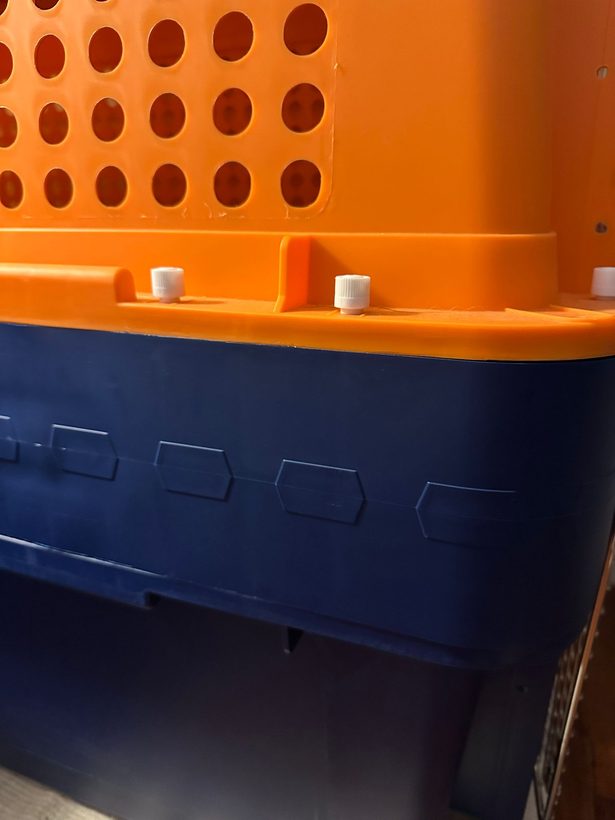
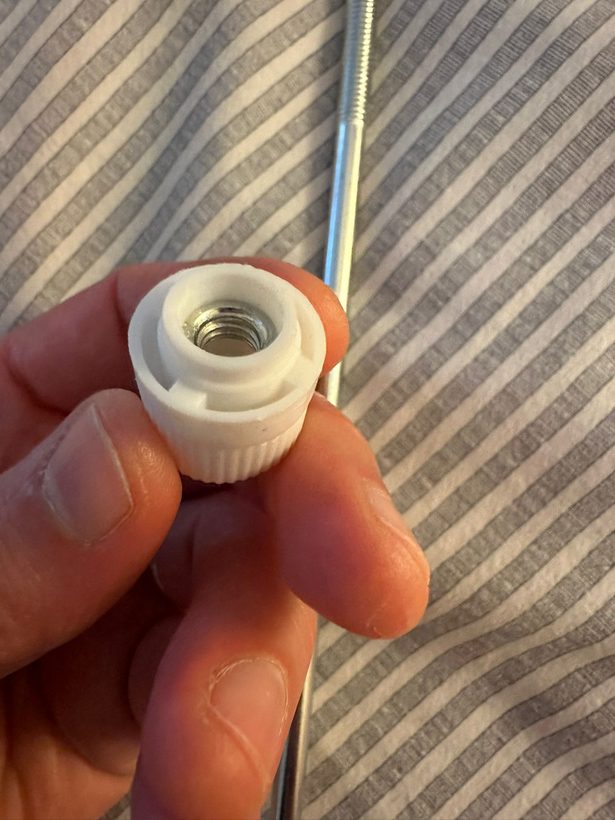
- Metal fastening. A two-piece plastic kennel must be bolted together with metal nuts and bolts. Crates held only by side snaps or dial latches are refused because they can pop open. Many good crates ship with metal hardware covered in black plastic caps — check before you replace anything.
- Ventilation on all four sides. Most airline crates have vents on the sides and a wire door at the front. If the back is solid, holes have to be added — see our crate mesh and ventilation guide.
- Nose- and paw-proof openings. Openings can be no larger than 25 x 25 mm (1 x 1 inch) for dogs and 19 x 19 mm (3/4 x 3/4 inch) for cats, and smaller if your pet can still push a nose or paw through.
- A secure front door. Metal or very rigid plastic, with a lock your pet cannot open. Welded door mesh should be at least 2.5 mm thick for dogs and 2.0 mm for cats. Crates that open only from the top are not accepted for cargo.
- No wheels. Remove them before check-in.
Step 1: Measure your pet
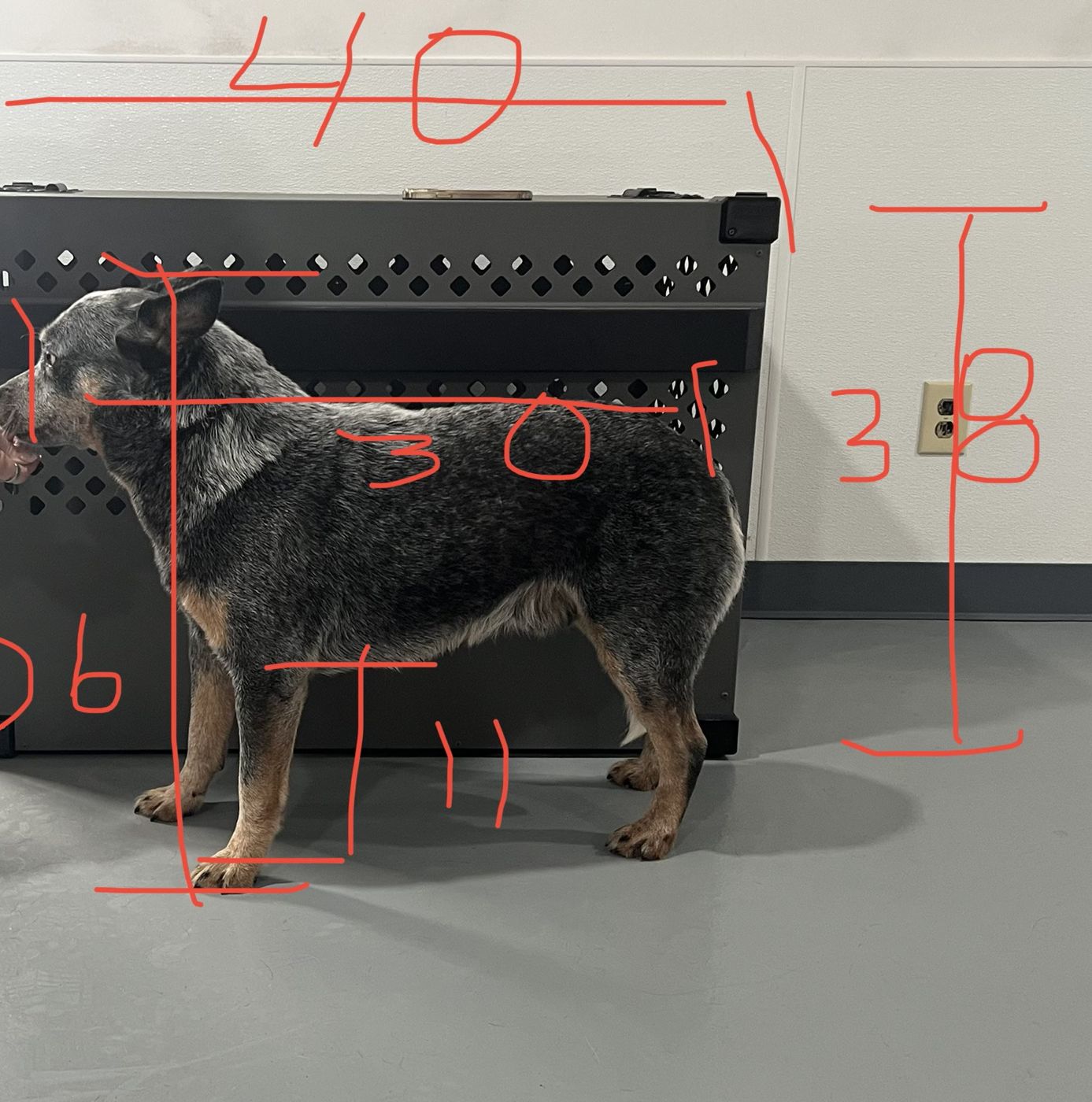
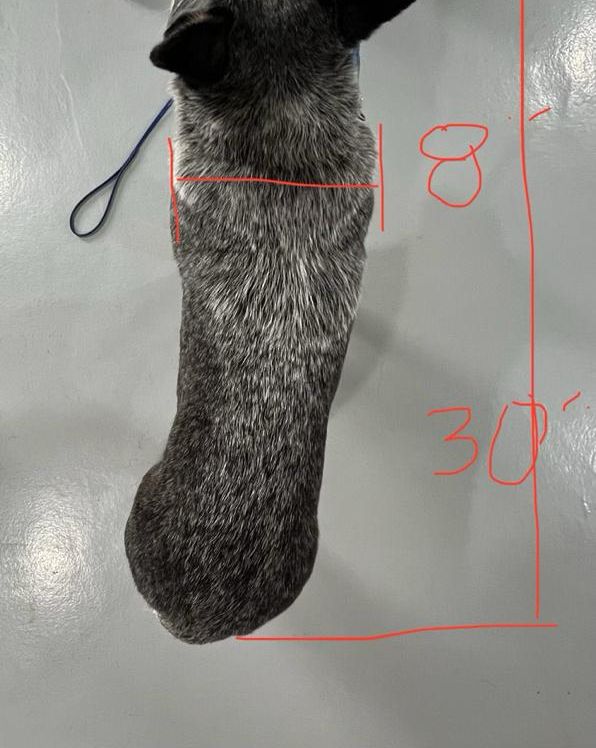
Measure with your pet standing naturally, ideally against a wall. You need four numbers:
| A | Length: tip of the nose to the base of the tail (not the tail itself) |
| B | Leg height: floor to the elbow |
| C | Width: across the shoulders, or the widest point of the body |
| D | Height: floor to the top of the head or the ear tips, whichever is higher, standing naturally |
Step 2: Work out the minimum inside dimensions
The IATA formula gives the smallest crate interior your pet can travel in:
| Inside length | A + half of B |
| Inside width | C x 2 |
| Inside height | D, plus room to stand without crouching — we look for about 3 inches above the head or ear tips |
A worked example. A dog measuring A = 28 in, B = 10 in, C = 9 in and D = 24 in needs at least 33 in inside length (28 + 5), 18 in inside width and about 27 in inside height. A Large (Series 400) kennel is 32 in long inside — one inch short — so this dog flies in an Extra Large (Series 500).
Cats
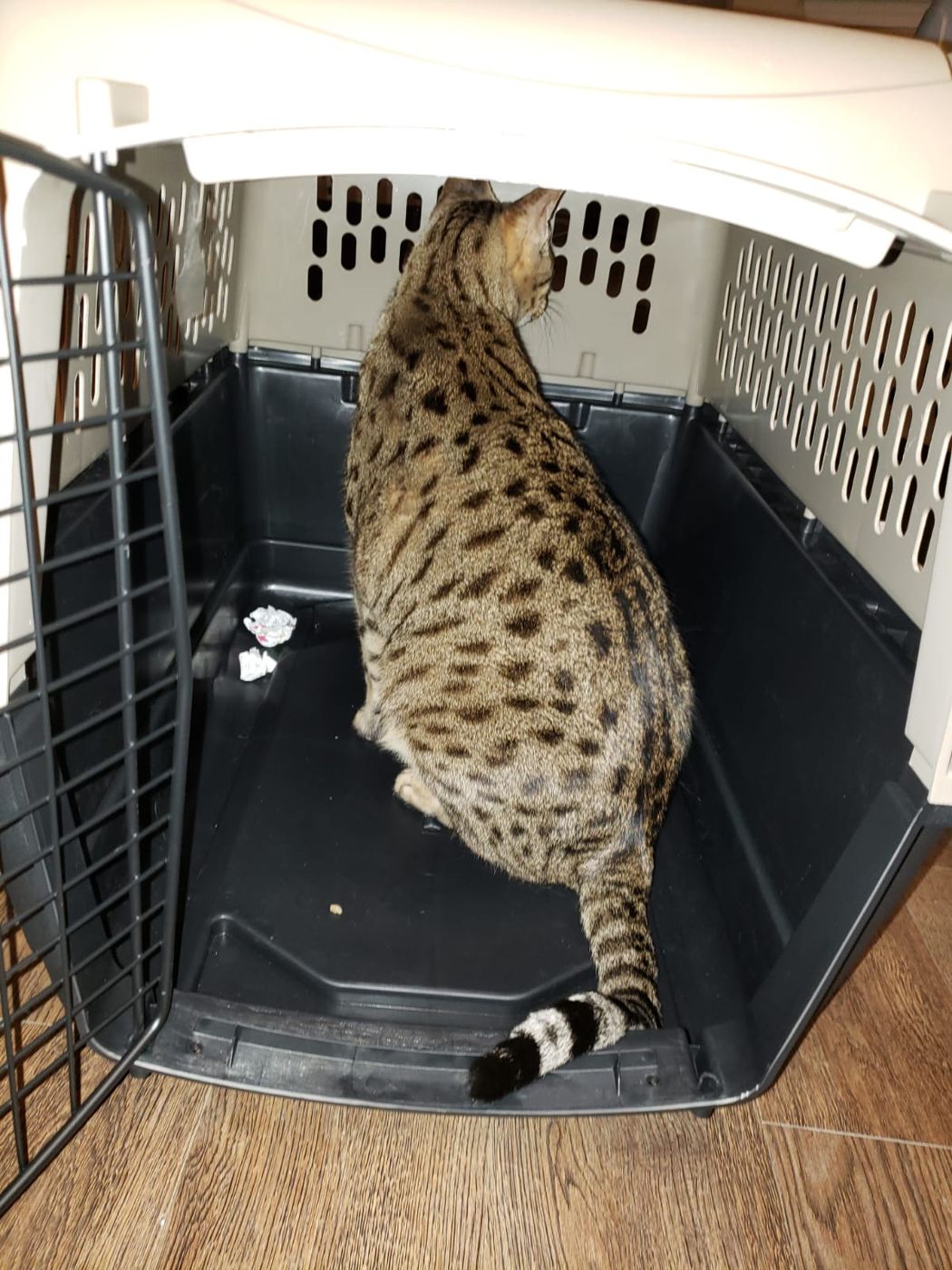
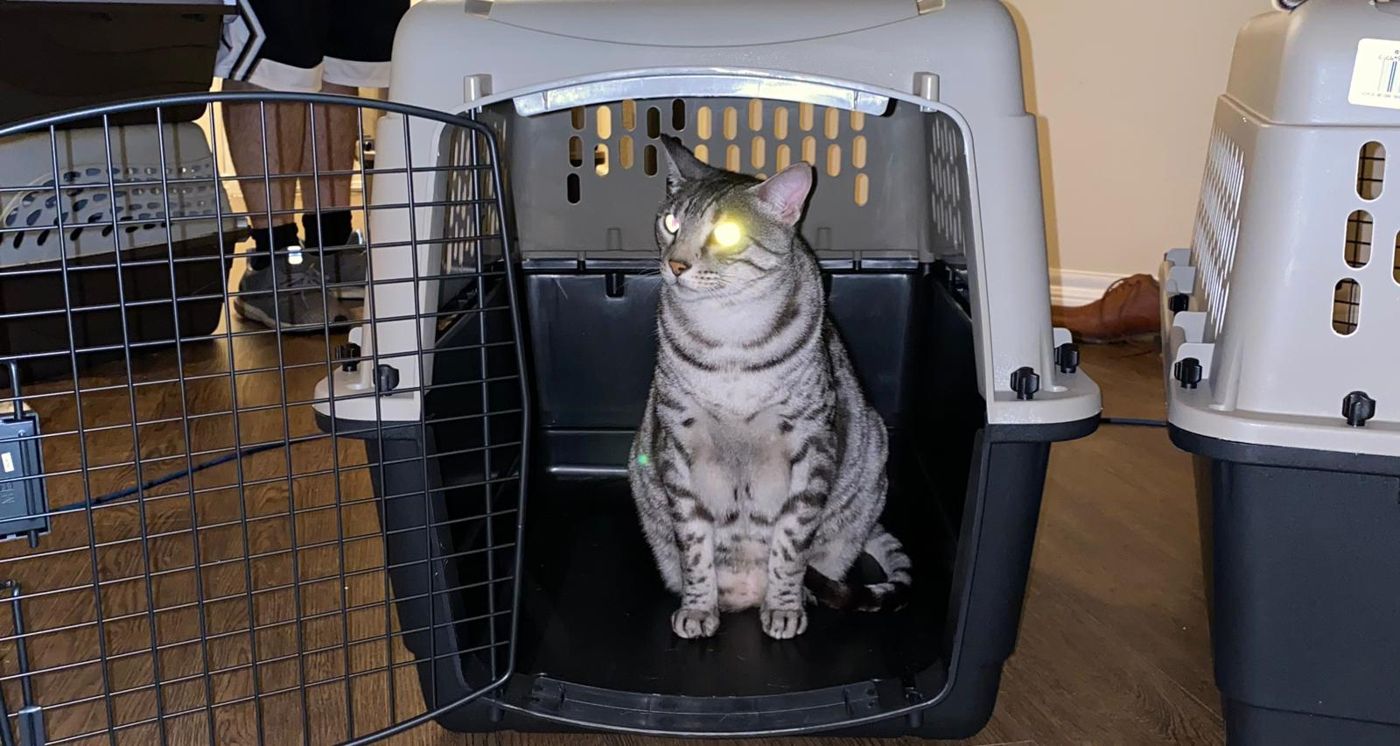
Cats are measured and sized with the same formula, and most fit a Small or Medium kennel. The one difference is the openings: for cats they can be no larger than 19 x 19 mm (3/4 x 3/4 inch), so a crate with wide side vents may need mesh.
Snub-nosed breeds
Snub-nosed breeds — Pugs, Bulldogs, French Bulldogs, Boxers, Persian cats and similar — breathe less efficiently, and many airlines require a crate about 10% larger in each dimension for them. The safe rule is one size up.
Step 3: Compare with the inside of the crate
Crates are sold by their outside dimensions. The walls, the roof curve and the door frame take several inches off every measurement, and the airline measures your pet against what is left. These are the standard plastic kennel sizes (Petmate Sky Kennel and Vari Kennel), outside and inside:
| Size | Outside (L x W x H) | Inside (L x W x H) | Crate weight |
|---|---|---|---|
| Small (100) | 21 x 16 x 15 in | 17.5 x 12 x 13 in | 6.25 lb |
| Medium (200) | 28 x 20.5 x 21.5 in | 23 x 16 x 19.5 in | 10.25 lb |
| Intermediate (300) | 32 x 22.5 x 25 in | 29 x 20 x 24 in | 14.9 lb |
| Large (400) | 35.5 x 25 x 28 in | 32 x 22 x 26 in | 18.5 lb |
| Extra Large (500) | 39.5 x 25 x 30 in | 36 x 24 x 28 in | 27 lb |
| Giant (700) | 48 x 32 x 35 in | 42.5 x 30 x 32.5 in | 51.5 lb |
Exact figures vary a little by manufacturer and model year. Your pet should have a couple of inches to spare in each direction; a crate that is much too big lets a pet slide around, and it costs more to fly because airlines charge by size as well as weight.
A real lesson: three large dogs, three refused crates
Big dogs are where sizing goes wrong most often, because the Giant is the largest standard plastic kennel. If your dog is at or near its limits, measure early — the options below take one to two weeks to arrive.
When your pet is between sizes
Height extenders
If your pet fits the length of a crate but not its height, a height extender — a collar that fits between the top and bottom halves of the kennel — adds about 3 to 5 inches of headroom. Extenders exist for the Extra Large and Giant sizes, come with the longer bolts needed to fit them, and usually take one to two weeks to ship. For many tall, lean dogs this is cheaper than a custom crate.
Larger plastic crates
For dogs that are too long for a Giant, Pet-Express makes larger plastic crates: the PP90 is about 52 in long, 31 in wide and 33 in high outside, and the PP100 has the same base with a 6-inch extender. They are sold online and take one to two weeks to deliver within the US.
Custom wooden crates
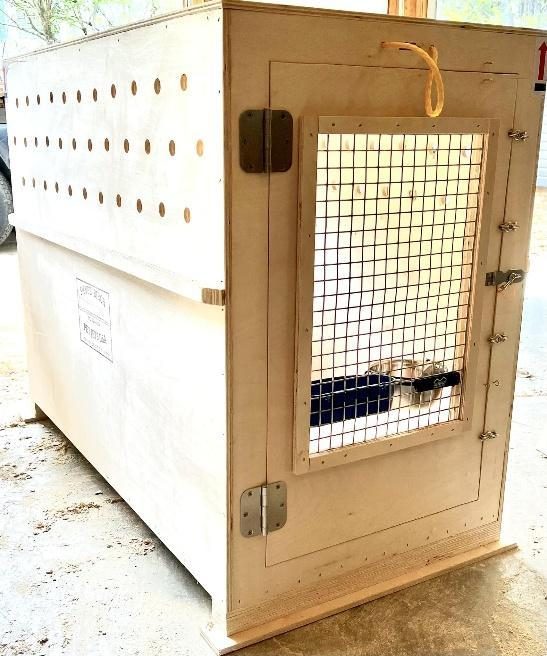
Giant breeds such as Great Danes sometimes fit nothing off the shelf. A custom wooden crate can be built to IATA specifications — solid wood of the right thickness, ventilation on all sides, a secure mesh door — but it has to be built precisely, so it is usually best arranged through your pet shipper. We arrange them when a pet needs one.
Crates we recommend
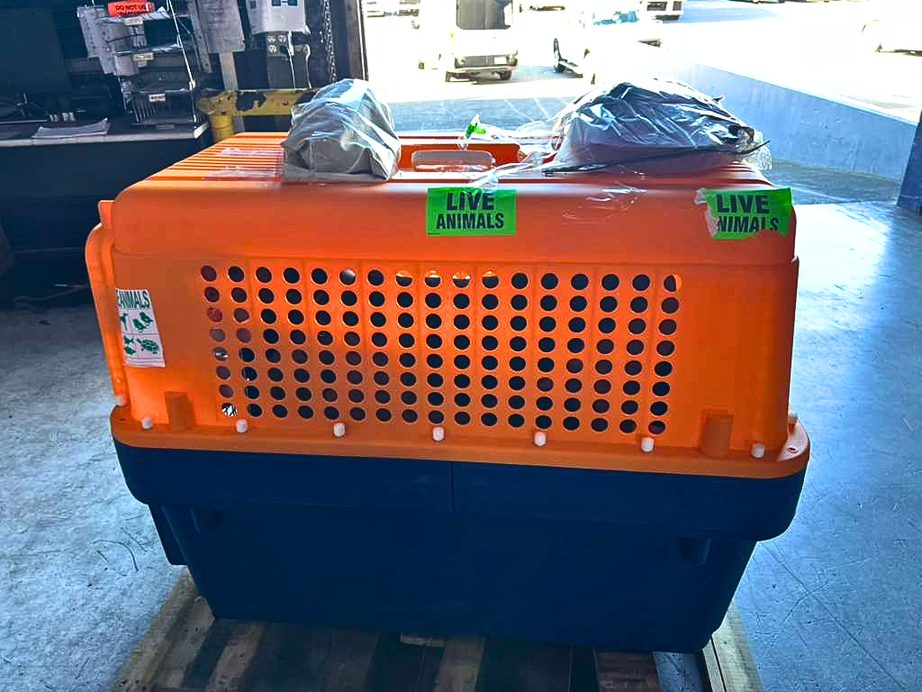
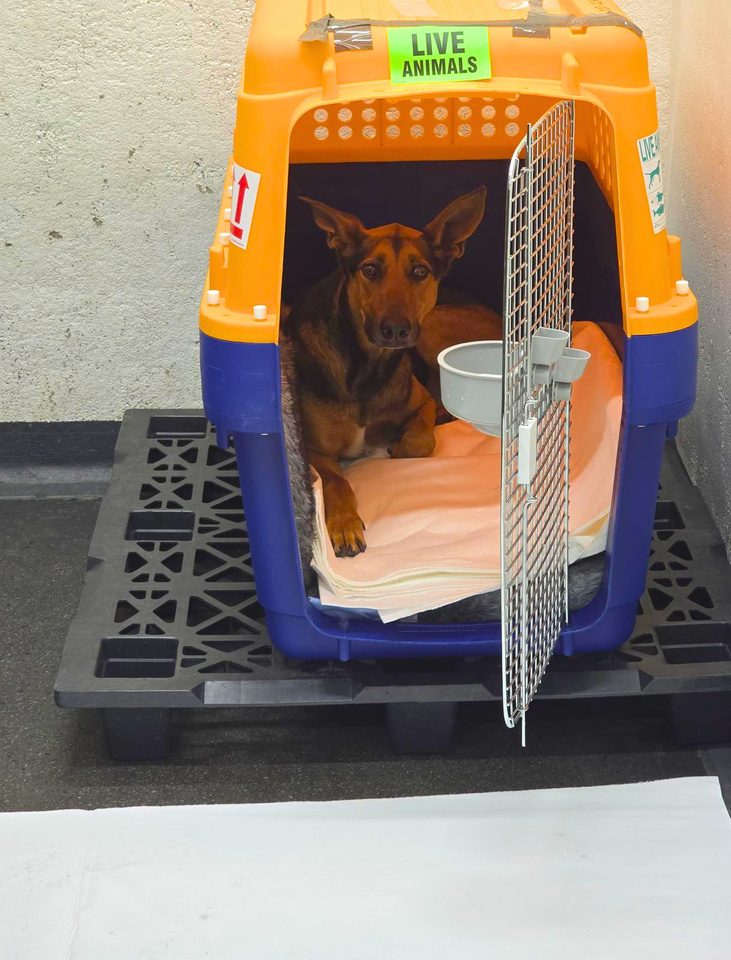
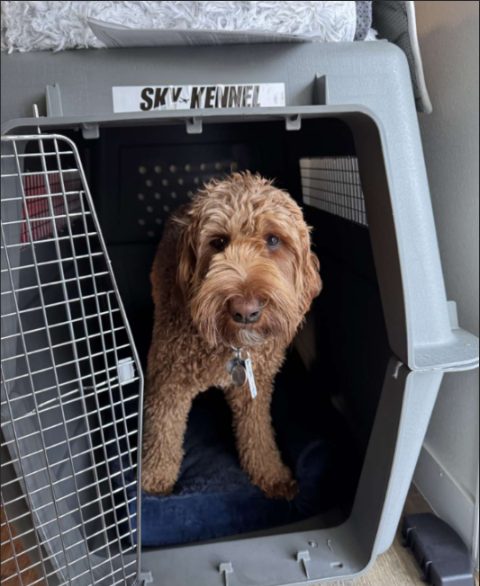
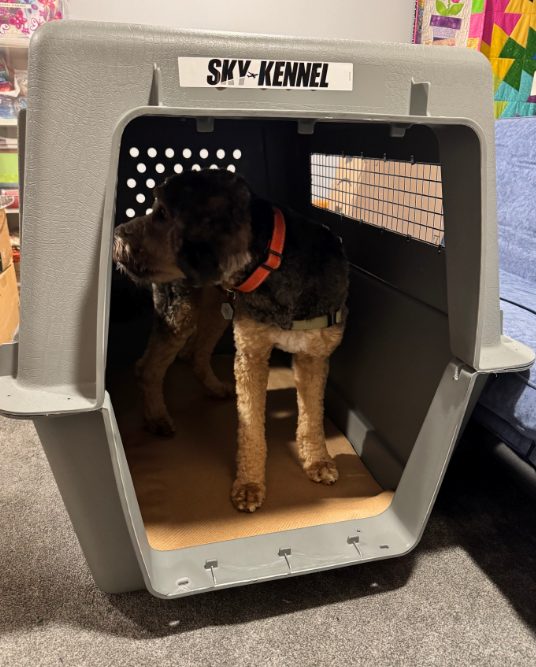
- Petmate Sky Kennel. Our default recommendation. Heavy-duty plastic, metal hardware, ventilation on all four sides, and it comes with the Live Animal stickers and bowls. Easy to assemble.
- Petmate Vari Kennel. Very similar to the Sky Kennel and equally accepted; common for cats and small to medium dogs.
- SportPet plastic kennels. Airline-compliant and often cheaper in large sizes. Swap any plastic wing nuts for metal nuts and bolts.
- Pet-Express PP90 / PP100. For dogs too long or tall for a Giant.
Crates airlines refuse
- Soft-sided carriers and fabric crates. Fine in the cabin, never in the hold.
- Wire home crates and folding metal pens. Not enclosed, and they can bend in transit.
- Collapsible or pop-up crates, including folding plastic ones — unless the manufacturer sells an IATA reinforcement kit for that model (Impact does).
- Top-opening carriers. The crate needs a front door.
- Crates held by plastic clips or dial latches. Drill and bolt them with metal hardware, or buy a different crate.
- Crates with wheels still attached.
Before you buy
- Measure your pet (A, B, C and D) and work out the minimum inside dimensions.
- Compare them with the inside dimensions of the crate, not the outside.
- Go one size up for a snub-nosed breed.
- Order early, and let your pet use the crate at home for a few weeks before the flight — see how to prepare the crate.
- If your pet is between sizes, send us the four measurements and a side-on photo. We check every client's measurements against the airline's rules before we book.